Tu B’Av is a day for celebration.On this full moon, the maidens of Yerushalayim go out in the vineyards dressed in white.
Circling on The Best of Days
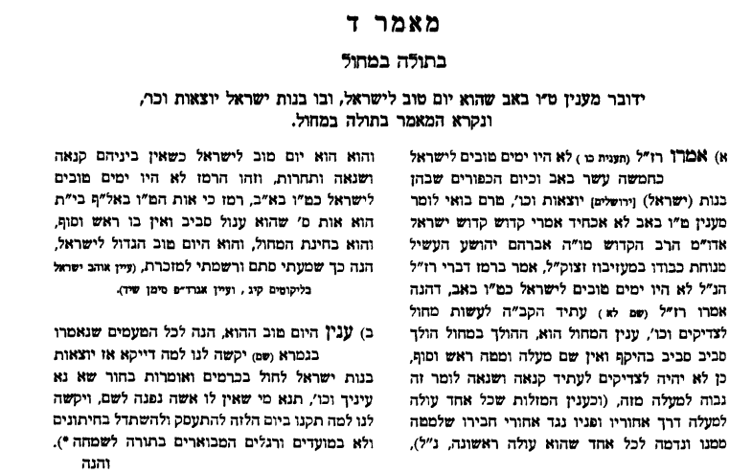
The Bnai Yisaskhar cites the passage below Taanit 29:b), concluding a discussion of the month of Av, as well as the tractate of Ta’anit, on a positive note.
Our sages (Rabbi Shimon ben Gamliel) said: There were no days as joyous for the Jewish people as the fifteenth of Av, and as Yom Kippur, as on them the daughters of Jerusalem would go out in white clothes, which each woman borrowed from another. Why were they borrowed? They did this so as not to embarrass one who did not have her own white garments. All the garments that the women borrowed require immersion (to be transformed and physically and spiritually cleaned).
And the daughters of Jerusalem would go out and dance in the vineyards. And what would they say? Young man, please lift your eyes and see what you choose for yourself for a wife. Do not set your eyes toward beauty, but set your eyes toward a good family, as the verse states: “Grace is deceitful and beauty is vaporous, but a woman in awe of Havayah. she shall be praised” (Proverbs 31:30), and it further says: “Give her the fruit of her hands, and let her works praise her in the gates” (Proverbs 31:31).י אִשָּׁה יִרְאַת ה׳ הִיא תִתְהַלָּל״, וְאוֹמֵר: ״תְּנוּ לָהּ מִפְּרִי יָדֶיהָ וִיהַלְלוּהָ בַשְּׁעָרִים מַעֲשֶׂיהָ״.
This can sound old-fashioned, even sexist, to contemporary ears.At the time it was written, this was a radical feminist perspective. Women were commonly treated as property, even as enslaved people at that time. In this passage. Rabbi Shimon offers wisdom on the usefulness of women contributing to and receiving credit for their work, as well as advice on what to look for in a life partner.
From Oy to Joy
Tu B’Av is a day of transition in Jewish practice. The challenges of Tisha b’Av and the three weeks of disintegration are in the past. The seven weeks of comfort have begun. This day invites movement from “Oy” of the three weeks and destruction of the Temple to the “Joy” of new beginnings, new love.
Tu B’Av is 40 days before the first day of creation, the 25th day of Elul. (Rosh Hashanah is the day humankind was created, according to tradition.)
FORTY
Forty is significant in the Jewish psyche – consider 40 days of rain that brought on Noah’s flood; the children of Israel spent 40 years in the desert; Moshe Rabaynu spent 40 years in Pharaoh’s palace, 40 years with Jethro, and 40 years leading the people in the desert, and on the Mountain with Source for 40 days. The letter Mem has a gematria of 40. Memrepresents water (mayim) and the transformative powers associated with water and ritual immersion.
POTENT & beautiful Circles
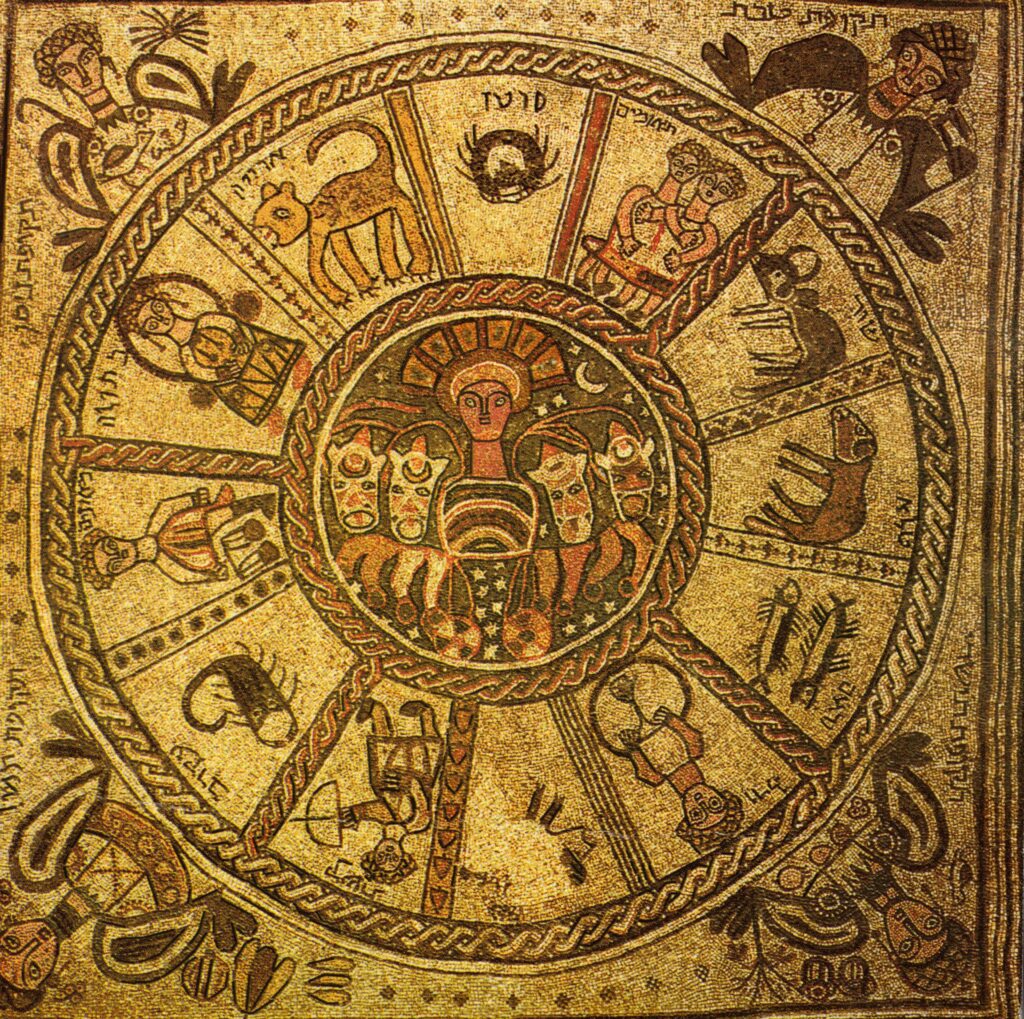
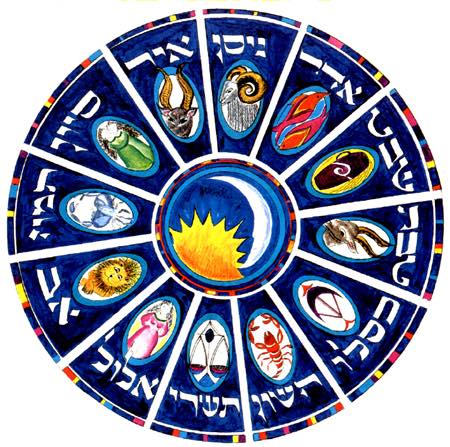
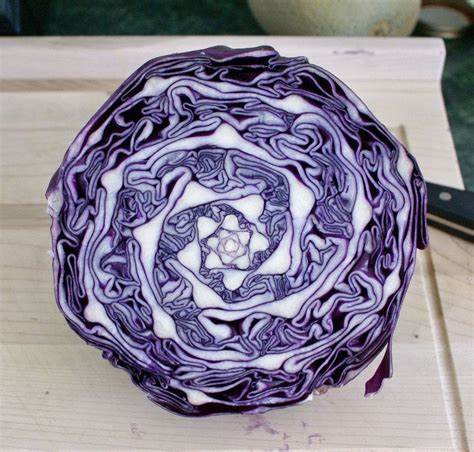
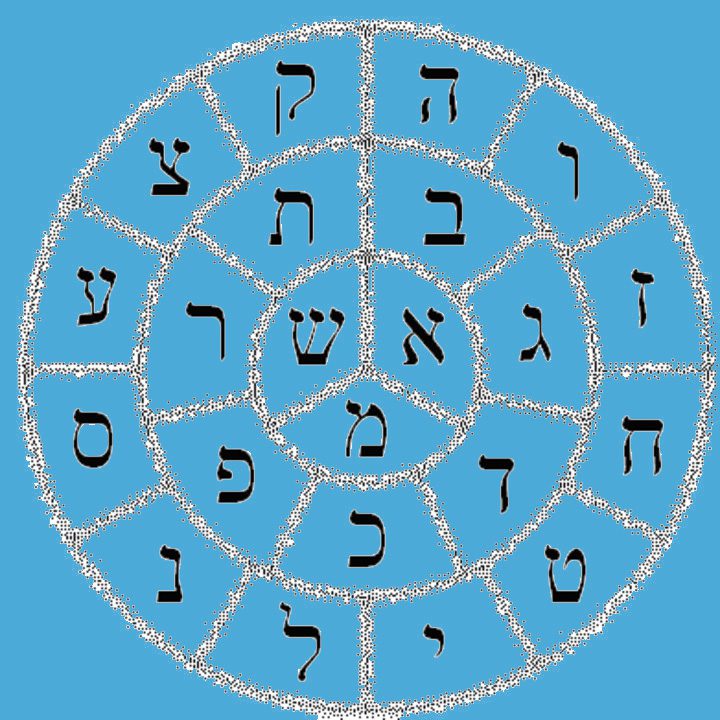
Constellations from the Beit Aleph Synagogue in IsraelConstellations and MonthsCabbageSunflowerSpiritual CirclesHoliFeminine Tree of Lifestic Jew
Circles are non-hierarchical; There is no high or low, nor up or down, beginning or end in a circle. All circle members have equal standing, equal import. Circles represent the Divine feminine, Sh’khinah. They invite Presence. On Tu B’Av we are invited to honor the sacredness of the circle. Circles are a potent available means of cultivating Presence.
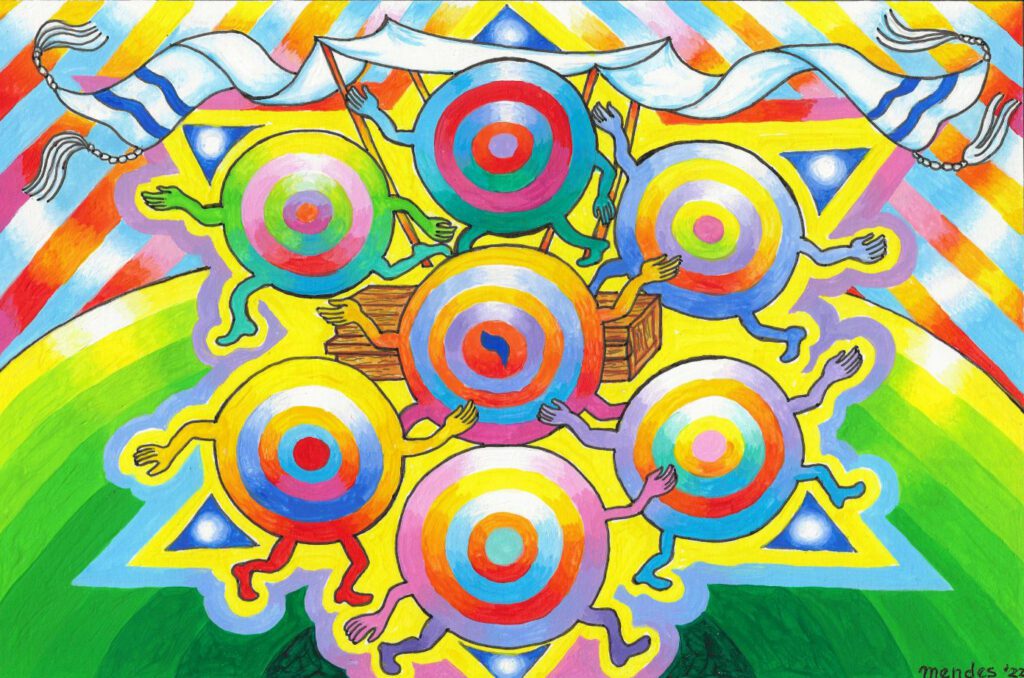
Sacred circling is a significant part of Jewish ritual: weddings, Sukkot, Simhat Torah, and when honoring someone who has died and is being prepared for burial. This is discussed further in my book, Seven Sacred Circles.
The Holy Rebbe Tzvi Elimelakh of Dinov, teaches from his book Sefer Bnay Yisaskhar. Section – Tammuz Av – Maamar 4:1
Before we talk about Tu B’Av, let’s get into alignment through the words of the holy Israelite, our master teacher, the holy Rabbi Avraham Yehoshua Heschel, may he rest in peace, from Medzhybizh, Ukraine, remembered for innocence, holiness, and blessings. He brings forward (with reference to the verses above) that our sages teach that in the future (times of Moshiah consciousness), the Holy One of Blessing will make a circle dance for the Tzaddikim (innocent, righteous), and the Holy One will sit among them in the Garden of Eden (Taanit 31).
The important aspect of the circle dance is that it goes round and round, creating a space; a portal in the center. There is no high or low, nor up or down, beginning or end in a circle. Similarly, the Tzaddikim of the future will not be subjected to jealousy or hatred, saying, ‘this is higher than that’.
This mirrors the way the constellations rise, one after the other, each one’s face seeing the back of the constellation that follows it. Each individual has a sense of importance and contributes to the whole.
This day is indeed a great day in Yisrael because when we convene in a circle, a sense of equality among the group tends to prevail. There is no room for jealousy or hatred.
This is what is meant by, “There were no days as joyous for the Jewish people as the fifteenth of Av, and as Yom Kippur…” (Tu B’Av is the full moon, 15th day of Av)
There is a clue of this in the Aleph Bet. It turns out that the fifteenth letter is the letter Samekh.
Samekh is the symbol of support, protection, and memory. It means to lean upon, support, uphold. The perimeter of Samekh denotes the Creator, and its interior denotes creation, which is constantly supported, upheld, and protected. It represents the Or Makif Surrounding Light of Kabbalah, indicating the general providence of the Creator, surrounding and sustaining all of existence, even as we perceive ourselves as separate. The Samekh is the container of all forms.
Samekh teaches us circular thinking. It tells us to think for the good of the whole, not just oneself (an ability that comes from the Neshama soul), and to be inclusive of everything and everyone. It is the principle that the wisdom is not contained in just one vessel, in just one person, but is distributed in all beings. The Samekh teaches us that in order to know our Creator, we have to get out of our limited selves, out of what we know and the limitations of the physical, so we can get in touch with our essential inner self. We must empty ourselves in order to be filled.
The Samekh models the importance of the circle, with no beginning nor end, like a circle in which we dance. Most importantly, the Samekh models The Creator’s ongoing Presence in the world. We dwell, individually and collectively, in an ongoing circle of Divine Love, now and always.
We use cookies to ensure that we give you the best experience on our website. If you continue to use this site we will assume that you are happy with it.